

Exchange of agreement between Ministry of Ethnic and Religious Affairs of Vietnam and Prime Minister of the Lao PDR’s Office
07:10 PM 08/06/2026 Views: 58 PrintOn June 7, 2026, at the Government Headquarters of Vietnam, a handover ceremony of Vietnam - Laos cooperation documents took place, witnessed by Prime Minister Lê Minh Hưng and Prime Minister of the Lao People's Democratic Republic Sonexay Siphandone.
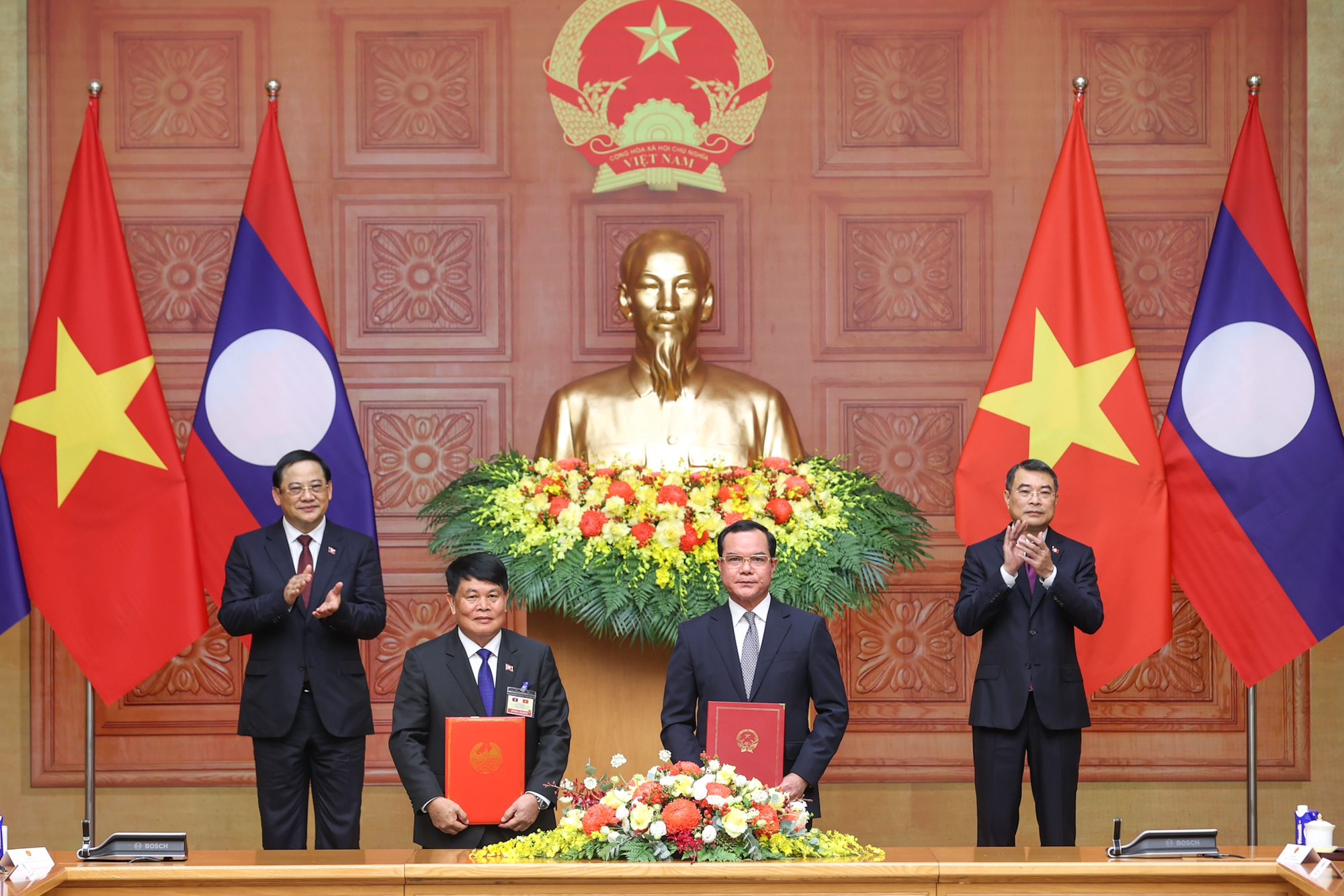
Minister of Ethnic and Religious Affairs Nguyễn Đình Khang and Minister, Head of the Office of the Prime Minister of the Lao PDR Buakhong Nammavong exchange the Agreement between the Ministry of Ethnic and Religious Affairs of Vietnam and the Office of the Prime Minister of the Lao PDR on ethnic and religious affairs for the 2026-2035 period, witnessed by Prime Minister Lê Minh Hưng and Prime Minister of the Lao People's Democratic Republic Sonexay Siphandone
At the event, Minister of Ethnic and Religious Affairs Nguyễn Đình Khang and Minister, Head of the Office of the Prime Minister of the Lao PDR Buakhong Nammavong exchanged the Agreement between the Ministry of Ethnic and Religious Affairs of Vietnam and the Office of the Prime Minister of the Lao PDR on ethnic and religious affairs for the 2026-2035 period.
Accordingly, the Agreement aims to expand cooperation in ethnic and religious affairs based on the aspirations and interests of the two peoples, thereby contributing to constantly consolidating, cultivating, and advancing the great friendship, special solidarity, comprehensive cooperation, and strategic partnership between Vietnam and Laos; with the desire to enhance cooperation in line with the functions, duties, and powers of both sides, while complying with relevant domestic laws and international treaties of each country.
This Agreement replaces the Cooperation Agreement between the Committee for Ethnic Minority Affairs (CEMA) of the Socialist Republic of Vietnam and the Ministry of Home Affairs of the Lao People's Democratic Republic on ethnic affairs for the 2022-2030 period.
The agreed Cooperation Agreement on ethnic and religious affairs for the 2026–2035 period consists of 7 Articles, specifically:
Article 1 identifies key cooperation areas and activities, including:
- Strengthening communication, mobilization, and dissemination among the people, especially the younger generation, regarding ethnic and religious guidelines and policies, as well as the tradition of great friendship and special solidarity between Vietnam and Laos.
- Promoting professional experience sharing, cadre training and capacity building, and scientific and technological research and application in ethnic and religious affairs.
- Promoting socio-economic development and poverty reduction in ethnic minority areas along the border by replicating models such as "Peaceful and friendly border village clusters".
- Enhancing environmental protection, climate change adaptation, and social welfare provision (promoting gender equality, improving health, and mitigating child marriage and consanguineous marriage).
- Coordinating to maintain border security and manage migration, preventing spontaneous migration and marriage without registration.
- Enhancing people-to-people exchange and twining arrangements between border localities, and commending prominent individuals, dignitaries and reputable persons in the community (influential persons).
Article 2 stipulates that the two sides will coordinate annually to propose including contents of this Agreement into the Appendix to the Cooperation Plan between the two Governments. On that basis, each side will submit specific bilateral cooperation activities to its respective Government.
Article 3 agrees on organizing annual delegation exchanges on an alternating basis (in Vietnam or Laos).
Article 4 addresses promoting and enhancing relations between agencies in charge of ethnic and religious affairs in border-adjacent provinces, respecting the laws of each country and signed cooperation treaties/agreements between Vietnam and Laos, contributing to consolidating the great friendship, special solidarity, and maintaining stability in the two countries' border areas.
Article 5 requires both sides to facilitate subordinate units in strengthening cooperation through delegation exchanges, conferences, seminars, joint research, and information sharing. The focal units of both sides shall take lead responsibility for monitoring, supervising, and reporting implementation progress to the leaders of the two agencies.
Article 6 regulates the settlement of issues arising during the implementation of the Agreement.
Article 7 affirms that this Agreement is not an international treaty and does not create legally binding rights and obligations for the two countries. The Agreement enters into force from the date of signing until replaced by another agreement.
Thuần Linh
THỐNG KÊ TRUY CẬP
Số lượt truy cập hiện tại: 48
Tổng số truy cập: